
01. How volume pricing actually works
Junk removal is priced by the fraction of the truck your material occupies after it has been loaded and compacted by the crew. Not by the hour, and not by how long the job takes. That distinction matters: with hourly pricing, a slow crew costs you more, and you cannot know the price until the work ends. With volume pricing, you know before anyone starts.
The practical implication is that loose, bulky material costs more than it seems like it should, and dense material costs less. A pile of empty boxes takes up enormous space and weighs nothing, so it prices high relative to its weight. A stack of paving stones takes up very little space but is heavy — that one prices by weight instead, which is the exception covered further down.
This is also why breaking things down before pickup can save money on a borderline job. A disassembled bed frame, collapsed boxes and a dismantled shelving unit take up meaningfully less truck space than the same items intact. If you are near the edge of a pricing tier, an hour of flattening boxes genuinely moves the number.
02. What each load size actually holds
Minimum load, starting at $99. A single piece of furniture, one appliance, a mattress and box spring, or roughly what fits in the bed of a standard pickup. A couch. A refrigerator. A dozen bags of household clutter. This covers the majority of single-item calls.
Quarter truck. Roughly a small bedroom's worth: a bed set, a dresser, a nightstand and some boxes. Or a modest garage corner cleared. Or the contents of a small shed.
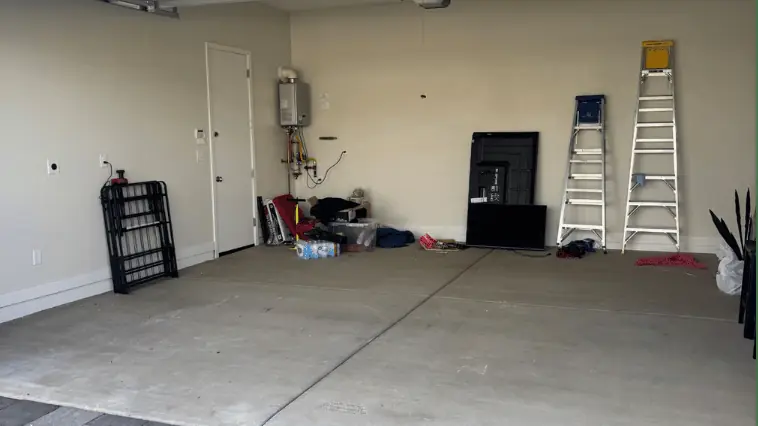
Half truck. A packed single-car garage, a full bedroom plus a living room set, or a small apartment's worth of furniture. This is the most common size for a serious household declutter.
Three-quarter to full truck. A two-car garage cleared floor to ceiling. The furnished contents of a one or two bedroom home. A full storage unit. Larger jobs run multiple truckloads, and that is normal for estate and hoarder work.
- Minimum load from $99 — one couch, one appliance, a mattress set, or a pickup bed
- Quarter truck — a small bedroom, a garage corner, a small shed's contents
- Half truck — a packed single-car garage or a small apartment's furniture
- Full truck — a two-car garage, or a one to two bedroom home's furnishings
- Multiple loads — estate cleanouts, hoarding situations, full property clears
03. What actually pushes the price up
Labor and access, more than anything. The same pile costs more from a third-floor apartment than a ground-floor garage, because every item is carried down by hand. Long carries from a back yard through a narrow side gate add real time. Disassembly adds real time — a shed, a playset, a hot tub, built-in shelving, a cubicle system.
Weight is the other one, and for a narrow set of materials it overrides volume entirely. Dirt, landscape rock, gravel, concrete, masonry and roofing material are priced by weight because a truck reaches its legal load limit long before the bed fills. A small-looking pile of broken concrete can be several tons, and that is covered in our piece on dirt, gravel and rock removal.
Then there is material that needs special handling: refrigerant-containing appliances requiring certified recovery, electronics routed to e-waste, mattresses, tires. These are not upcharges invented to pad a bill — they reflect genuinely different disposal paths with different costs behind them.
04. Estimating your own job before you call
Use a car as your measuring stick. Stand where your pile is and ask whether it would fill the trunk of a sedan, the bed of a pickup, half a cargo van, or an entire van. That maps closely enough to the tiers above to get you in the right range.
For a room, a reliable shortcut: a fully furnished bedroom is roughly a quarter truck. A fully furnished living room is roughly a quarter to a third. A packed single-car garage is roughly a half. Add them up for a multi-room job and you will land close.
Then take photographs and send them. Every honest quote on a sight-unseen job is a range; a few photos convert that into a firm number. Photograph the whole pile from a distance so scale is visible, then anything unusual close up, plus the path out — the doorway, the stairs, the gate. That is what lets us quote accurately instead of hedging.
05. Why two companies quote the same pile differently
Three legitimate reasons, and one that is not. The legitimate ones: different trucks hold different volumes, so a quarter truck at one company is not a quarter truck at another; different companies route material to different disposal facilities with different tipping fees, and a company that sorts for donation and recycling pays more in sorting labor but less in landfill fees; and some quotes include labor and some assume you have already moved everything to the curb.
The one that is not legitimate: a quote given over the phone that is designed to win the booking and get revised upward on arrival. The pattern is recognizable — a number notably below everyone else, given without photos or questions, followed by a crew who discovers the job is bigger than described. By then you have taken a day off work and the furniture is already half-loaded.
The protection is simple. Get the price in writing before work begins, confirm it covers labor and disposal, and confirm what would change it. Any company unwilling to put a number in writing before starting is telling you something. We lock the quote before the crew touches anything, which is the whole point.
06. How to spend less
Bundle. One trip with the garage, the old mattress and the dead refrigerator costs far less than three separate pickups, because you are paying for the truck and crew being there as much as for the volume.
Use Mesa's bulk trash program for what qualifies. If your material is ordinary household bulk and your collection window is reasonably close, that is free and we will say so. Save paid removal for what the city will not take, what cannot sit at the curb, or what has to come out of the house.
Sell or donate the genuinely valuable items first, because that reduces volume and may offset the cost. Break down what you can — flatten boxes, disassemble bed frames and shelving. And book in advance rather than at the last minute when you are in a bind, since a planned job gives you room to compare quotes rather than taking whoever can come today.
- Bundle everything into one trip rather than booking repeatedly
- Use bulk trash for qualifying household material when the timing works
- Donate or sell the genuinely valuable items before quoting
- Flatten boxes and disassemble frames and shelving to reduce volume
- Book ahead rather than in an emergency, so you can compare
- Junk removal in Mesa starts at $99, with published starting prices for every residential service and walkthrough quotes for office and hoarder work.
- Pricing is by the truck fraction your material occupies after loading, not by the hour — so you get the number before work begins.
- A packed single-car garage is roughly a half truck; a fully furnished bedroom is roughly a quarter.
- Dirt, rock, concrete and masonry are the exception and price by weight, because trucks hit legal load limits long before the bed fills.
- Bundling several items into one trip and flattening or disassembling bulky items are the two biggest levers on what you pay.
Common questions
It starts at $99 for a minimum load — roughly a pickup bed, a single couch, one appliance or a mattress set. Larger jobs are priced by the fraction of the truck your material fills after loading, and the number is locked before the crew starts. Specialty services have their own starting prices, from $199 for storage unit cleanouts up to $599 for estate cleanouts.
Use a vehicle as a yardstick: would the pile fill a car trunk, a pickup bed, half a cargo van, or a whole van? As a rule of thumb, a fully furnished bedroom is about a quarter truck, a packed single-car garage is about a half, and a two-car garage cleared out is close to a full load.
No. Pricing is by volume — the share of the truck your material occupies — plus labor and access factors we identify up front. Hourly pricing means a slower crew costs you more and you cannot know the total until the job ends. Volume pricing means you get a fixed number before anything is touched.
Because dense material hits a truck's legal weight limit long before it fills the bed. A cubic yard of soil is roughly a ton and broken concrete is closer to two, so those jobs are quoted by weight after assessment rather than by the volume they appear to occupy.
Sometimes legitimately — truck sizes differ, disposal fees differ, and some quotes assume you have already moved everything to the curb. Sometimes not: a number well below everyone else given without photos or questions, then revised upward once the crew arrives, is a recognizable pattern. Get the price in writing before work starts and confirm it includes labor and disposal.
Use Mesa's bulk trash program for qualifying household material if your collection window is close — it costs nothing beyond your city services. Then bundle everything the program will not take into a single paid trip rather than several, donate or sell what has real value first, and flatten boxes and disassemble furniture to cut volume.
Need junk removal in Mesa?
Upfront pricing, insured crews, and we do all the lifting. 5/5 from 170+ neighbors.